
Complete Learning Path from Beginner to Architect
Estimated Reading Time: 15 Minutes
Introduction
Java remains one of the most popular programming languages for enterprise backend development. Modern Java Backend Developers are expected to build secure, scalable, and cloud-native applications using technologies like Spring Boot, Microservices, Kafka, Docker, Kubernetes, and AWS.
If you’re confused about what to learn after Java or wondering which technologies companies expect in 2026, this roadmap will guide you step by step.
Whether you’re a fresher, an experienced Java developer, or preparing for interviews, this learning path will help you understand the complete backend ecosystem.
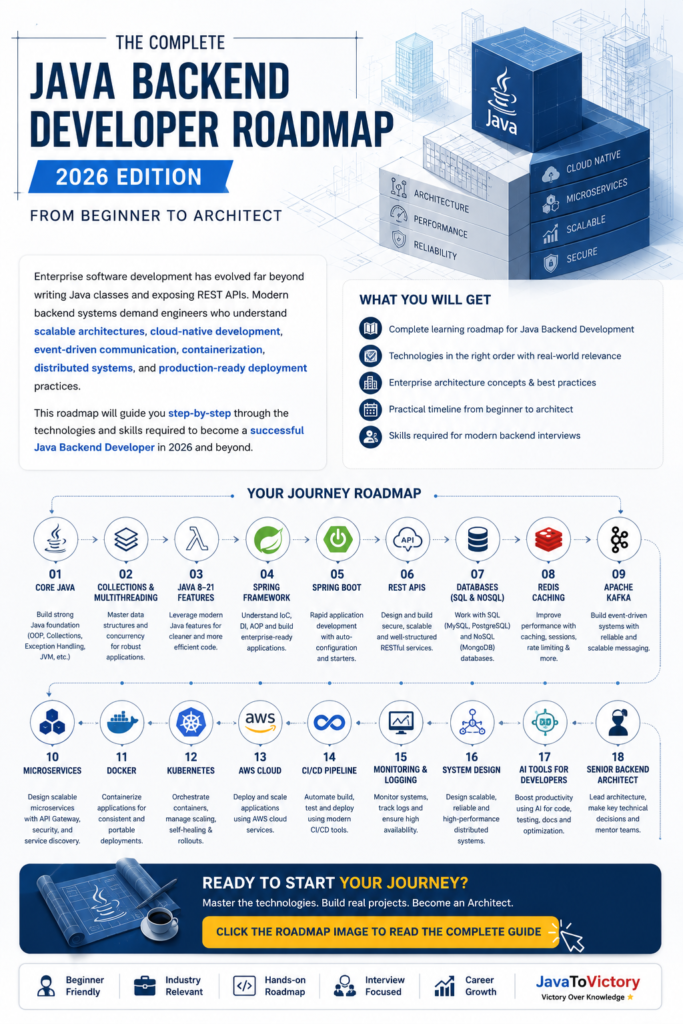
Java Backend Developer Roadmap
Core Java
     ↓
Collections & Multithreading
     ↓
Java 8–21 Features
     ↓
Spring Framework
     ↓
Spring Boot
     ↓
REST APIs
     ↓
SQL & JPA
     ↓
MongoDB
     ↓
Redis
     ↓
Apache Kafka
     ↓
Microservices
     ↓
Docker
     ↓
Kubernetes
     ↓
AWS Cloud
     ↓
CI/CD
     ↓
Monitoring
     ↓
System Design
     ↓
AI Tools
Step 1: Learn Core Java
Core Java is the foundation of backend development. Every framework, including Spring Boot, is built on Java concepts.
Why Learn It?
Without a strong Java foundation, understanding frameworks becomes difficult.
Topics to Learn
- Variables & Data Types
- Operators
- OOP Concepts
- Constructors
- Inheritance
- Polymorphism
- Abstraction
- Encapsulation
- Interfaces
- Exception Handling
- Generics
- Enums
Interview Topics
- String vs StringBuilder
- HashMap Internal Working
- equals() vs hashCode()
- JVM Memory
- Garbage Collection
Estimated Time: 4–6 Weeks
Step 2: Master Collections & Multithreading
Collections help manage data efficiently, while Multithreading enables applications to handle multiple tasks simultaneously.
Topics to Learn
Collections
- List
- Set
- Map
- Queue
- Comparable
- Comparator
Multithreading
- Thread
- Runnable
- Callable
- Executor Framework
- Future
- CompletableFuture
- Synchronization
- Locks
Interview Topics
- HashMap vs ConcurrentHashMap
- ArrayList vs LinkedList
- synchronized vs Lock
- Deadlock
- Thread Pool
Estimated Time: 3 Weeks
Step 3: Learn Java 8–21 Features
Modern enterprise applications heavily use Java 8+ features.
Topics to Learn
- Lambda Expressions
- Functional Interfaces
- Stream API
- Optional
- Method References
- Date & Time API
- Records
- Text Blocks
- Switch Expressions
- Virtual Threads (Java 21)
Why It Matters
Almost every Java interview includes Java 8 questions.
Step 4: Learn Spring Framework
Spring simplifies enterprise application development using Dependency Injection and Inversion of Control.
Topics
- Spring Core
- IoC
- Dependency Injection
- Bean Lifecycle
- Spring MVC
- AOP
Real Project Usage
Spring manages object creation, dependency management, and cross-cutting concerns such as logging and transactions.
Step 5: Learn Spring Boot
Spring Boot accelerates development by eliminating configuration overhead.
Topics
- Auto Configuration
- Starter Dependencies
- Profiles
- External Configuration
- Validation
- Logging
- Spring Security
- Actuator
Real Project Usage
Nearly every enterprise Java application today uses Spring Boot for developing REST APIs and Microservices.
Step 6: Build REST APIs
REST APIs allow frontend applications and other services to communicate with your backend.
Learn
- CRUD Operations
- HTTP Methods
- Status Codes
- Validation
- Exception Handling
- Pagination
- Sorting
- Filtering
- Swagger/OpenAPI
Real Project Usage
Mobile apps, websites, and third-party systems communicate with backend services through REST APIs.
Step 7: Learn Databases
Backend developers should understand both relational and NoSQL databases.
SQL
Learn
- MySQL
- PostgreSQL
- Joins
- Transactions
- Indexes
- Stored Procedures
NoSQL
Learn
- MongoDB
- DynamoDB
Why Learn Both?
Enterprise applications often use SQL for transactional data and NoSQL for flexible, high-volume data.
Step 8: Master Spring Data JPA & Hibernate
JPA simplifies database interaction and reduces boilerplate code.
Topics
- Entity Mapping
- Relationships
- JPQL
- Criteria API
- Pagination
- Lazy vs Eager Loading
- Optimistic Locking
Interview Topics
- N+1 Query Problem
- Cascade Types
- Fetch Types
Step 9: Learn Redis
Redis is an in-memory database used for improving application performance.
Common Uses
- API Cache
- Session Storage
- OTP Storage
- Rate Limiting
- Distributed Locking
Benefits
- Faster response times
- Reduced database load
Step 10: Learn Apache Kafka
Kafka enables asynchronous communication between services.
Topics
- Topics
- Partitions
- Producers
- Consumers
- Consumer Groups
- Retry
- Dead Letter Queue
- Offset Management
Real Project Usage
Order processing, notifications, payment systems, audit logging, and event-driven architectures.
Step 11: Learn Microservices
Microservices divide large applications into independently deployable services.
Topics
- API Gateway
- Service Communication
- Configuration Management
- Circuit Breaker
- Distributed Transactions
- Centralized Logging
Benefits
- Independent deployment
- Better scalability
- Easier maintenance
Step 12: Learn Docker
Docker packages applications into lightweight containers.
Learn
- Docker Images
- Dockerfile
- Docker Compose
- Volumes
- Networks
Why Learn?
Developers can run the same application consistently across development, testing, and production environments.
Step 13: Learn Kubernetes
Kubernetes automates deployment, scaling, and management of containerized applications.
Topics
- Pods
- Deployments
- ReplicaSets
- Services
- ConfigMaps
- Secrets
- Ingress
- Horizontal Pod Autoscaler
Real Project Usage
Most enterprise cloud applications run on Kubernetes.
Step 14: Learn AWS Cloud
Cloud platforms are now standard in enterprise applications.
Compute
- EC2
- ECS
- EKS
- Lambda
Storage
- S3
- EFS
Databases
- RDS
- DynamoDB
Networking
- VPC
- Load Balancer
Monitoring
- CloudWatch
Security
- IAM
- Secrets Manager
Messaging
- SNS
- SQS
Step 15: Learn CI/CD
Continuous Integration and Continuous Deployment automate software delivery.
Popular Tools
- Git
- GitHub
- Jenkins
- GitHub Actions
- Maven
- Gradle
- SonarQube
Why Learn?
Automation reduces deployment time and improves software quality.
Step 16: Learn Monitoring & Logging
Monitoring helps teams identify and resolve production issues quickly.
Popular Tools
- Splunk
- ELK Stack
- Prometheus
- Grafana
What to Monitor?
- Application Logs
- CPU Usage
- Memory Usage
- API Response Time
- Error Rate
Step 17: Learn System Design
System Design is one of the most important skills for senior backend developers.
Topics
- Scalability
- Load Balancing
- Caching
- Database Sharding
- High Availability
- CAP Theorem
- Event-Driven Architecture
Interview Examples
- Design URL Shortener
- Design WhatsApp
- Design Notification System
- Design Food Delivery App
Step 18: Use AI Tools Effectively
AI is changing how developers write and review code.
Practical Use Cases
- Generate Unit Tests
- Explain Legacy Code
- Create API Documentation
- Review Pull Requests
- Optimize SQL Queries
- Generate Dockerfiles
- Debug Exceptions
Remember: AI is a productivity tool. Strong Java and software engineering fundamentals remain essential.
Suggested Learning Timeline
| Experience | Focus Areas |
|---|---|
| Month 1–2 | Core Java, Collections, OOP |
| Month 3 | Java 8 Features |
| Month 4–5 | Spring & Spring Boot |
| Month 6 | REST APIs & JPA |
| Month 7 | SQL, MongoDB & Redis |
| Month 8 | Kafka & Microservices |
| Month 9 | Docker & Kubernetes |
| Month 10 | AWS |
| Month 11 | CI/CD & Monitoring |
| Month 12 | System Design & Interview Preparation |
Backend Developer Skills Checklist
- ✅ Core Java
- ✅ Collections Framework
- ✅ Multithreading
- ✅ Java 8–21
- ✅ Spring Framework
- ✅ Spring Boot
- ✅ REST APIs
- ✅ Spring Security
- ✅ SQL
- ✅ JPA & Hibernate
- ✅ MongoDB
- ✅ Redis
- ✅ Apache Kafka
- ✅ Microservices
- ✅ Docker
- ✅ Kubernetes
- ✅ AWS Cloud
- ✅ Git & GitHub
- ✅ Jenkins / CI-CD
- ✅ Monitoring & Logging
- ✅ System Design
- ✅ AI Development Tools
Conclusion
Becoming a successful Java Backend Developer is a journey that builds on strong fundamentals. Focus on mastering one topic at a time instead of trying to learn everything simultaneously. As you progress, connect these technologies by building real-world projects, practicing coding challenges, and preparing for interviews. Over time, you’ll develop the skills needed to design, build, deploy, and maintain modern enterprise applications.